Abstract
This article examines the strategic equilibrium of civil-military relations in democratic Malawi, focusing on the effectiveness of institutional actors in striking a balance between military professionalism and democratic accountability. Drawing on qualitative data from 65 informants across the judiciary, legislature, civil society, and the Malawi Defence Force (MDF), the study conceptualizes effectiveness as a dynamic interplay of constitutional fidelity, participatory engagement, and operational legitimacy. It integrates four theoretical traditions: Huntington’s Institutional Theory, Schiff’s Concordance Theory, Feaver’s Agency Theory, and Janowitz’s sociological perspective, providing a multidimensional lens for evaluating actor performance in transitional democracies. The Rhombus Diamond Framework is introduced as a diagnostic tool that positions the military as a fulcrum balancing four civilian nodes: elected authorities, civil authorities, civil society/media, and the judiciary. Effectiveness is assessed using five indicators: deliberative participation, monitoring mechanisms, judicial responsiveness, operational satisfaction, and peace/security outcomes. Findings reveal that while the MDF enjoys high public trust and operational competence, civilian actors face persistent challenges, including technical capacity gaps, politicization, and institutional inertia. Comparative insights from Ghana, Zambia, and Argentina underscore the importance of meritocracy, civic education, and institutional integrity in fostering effective civil-military relations. The study highlights the need for recalibrated actor roles, joint training programs, and decentralized security structures to bridge the familiarity gap and enhance participatory governance. By integrating indigenous epistemology with comparative analysis, the article presents a context-sensitive model for assessing institutional performance and informing policy reform. Ultimately, this study contributes to academic and policy debates by offering a grounded, actor-specific framework for strengthening democratic oversight and sustaining strategic equilibrium in civil-military relations. It advocates for embedding the Rhombus Diamond Framework into national security policy to promote balanced governance, safeguard constitutionalism, and ensure resilient civil-military synergy in transitional democratic contexts.
Keywords
Strategic Equilibrium, Transitional Democracies, Civil-Military Effectiveness, Institutional Legitimacy,
Rhombus Diamond Framework
1. Introduction
Civil-military relations (CMR) constitute a foundational pillar of democratic governance, particularly in transitional states navigating the legacies of authoritarian rule. The recalibration of roles between military institutions and civilian authorities is not merely a procedural adjustment but a strategic imperative for democratic consolidation. In such contexts, the effectiveness of CMR actors—defined by their ability to uphold constitutional norms, engage constructively, and maintain operational legitimacy—becomes a critical measure of institutional maturity and political stability.
Malawi’s reintroduction of multiparty democracy in 1994 marked a significant turning point in its political trajectory. Emerging from a one-party regime under President Hastings Kamuzu Banda, the country embarked on a complex journey of institutional reform, civic reawakening, and normative realignment. Central to this transition was the repositioning of the Malawi Defence Force (MDF) from a regime-protective apparatus to a constitutionally mandated national security institution. The MDF’s evolving role—spanning disaster response, election logistics, and examination security—reflects both its operational versatility and the trust it commands among citizens. However, this expansion also raises questions about role boundaries, democratic oversight, and institutional equilibrium.
This article addresses Objective 3 of a broader doctoral study on civil-military equilibrium in Malawi: to examine the effectiveness of key CMR actors in sustaining a balance between military professionalism and democratic accountability. Effectiveness, in this context, is not a static attribute but a negotiated outcome shaped by historical legacies, institutional design, and sociopolitical dynamics. It involves the capacity of actors to fulfill their mandates, engage in deliberative processes, and contribute to peace and security outcomes without undermining democratic norms and principles.
The study adopts a context-sensitive approach, integrating indigenous epistemology with comparative analysis. It introduces the Rhombus Diamond Framework
| [2] | Chazema, T. A. (2024). Reframing civil-military equilibrium in transitional democracies: Indigenous models and strategic diagnostics from Malawi. AfroISME Working Paper Series, 3(1), 15-38. |
| [3] | Chazema, T. A. (2025). Balancing Power and Democracy: A Framework for Managing Civil-Military Relations in Democratic Malawi (PhD Thesis). Mzuzu University. |
[2, 3]
as a diagnostic tool for evaluating the effectiveness of actors. This framework positions the military as a fulcrum balancing four civilian actors—elected authorities, civil authorities, civil society/media, and the judiciary—each with distinct but interdependent roles in shaping CMR outcomes. By mapping effectiveness across these nodes, the framework enables a nuanced understanding of institutional performance and strategic gaps.
The article also situates Malawi’s experience within a broader Global South discourse, drawing comparative insights from Ghana, Zambia, and Argentina. These cases illustrate how meritocracy, civic education, and institutional integrity can enhance CMR effectiveness, particularly in contexts marked by historical fragility and evolving democratic norms.
Ultimately, this study contributes to both academic and policy debates on civil-military synergy. It offers empirical evidence and theoretical grounding for recalibrating actor roles, strengthening oversight mechanisms, and embedding democratic values within security institutions. As Malawi continues its democratic consolidation, understanding and improving the effectiveness of CMR actors remains essential for safeguarding constitutionalism, promoting participatory governance, and ensuring sustainable peace.
2. Theoretical Framework
This study adopts a hybrid theoretical lens to interrogate the effectiveness of civil-military relations (CMR) actors in democratic Malawi. Four foundational traditions—Huntington’s Institutional Theory, Schiff’s Concordance Theory, Feaver’s Agency Theory, and Janowitz’s sociological perspective
| [4] | Feaver, P. D. (1996). The Civil-Military Problem: Huntington, Janowitz, and the Question of Civilian Control. Armed Forces & Society, 23(2), 149-178.
https://doi.org/10.1177/0095327X9602300203 |
| [6] | Huntington, S. P. (1957). The soldier and the state: The theory and politics of civil-military relations. Harvard University Press. |
| [7] | Janowitz, M. (1960). The professional soldier: A social and political portrait. Free Press. |
| [9] | Schiff, R. (1995). Civil-military relations reconsidered: A theory of concordance. Armed Forces & Society, 22(1), 7-24.
https://doi.org/10.1177/0095327X9502200102 |
[4, 6, 7, 9]
—are synthesized to provide a multidimensional understanding of effectiveness in transitional democracies.
Samuel Huntington’s Institutional Theory remains a cornerstone of CMR scholarship. He argues that military professionalism is best preserved through “objective civilian control,” wherein the military is granted autonomy in operational matters but remains subordinate to civilian authority
| [6] | Huntington, S. P. (1957). The soldier and the state: The theory and politics of civil-military relations. Harvard University Press. |
| [11] | Welch, C. E. (1976). Civilian Control of the Military: Theory and Cases from Developing Countries. SUNY Press. |
[6, 11]
. This model assumes a clear division of labor between political leaders and military professionals, with effectiveness rooted in institutional differentiation and functional specialization. In the Malawian context, Huntington’s framework helps explain the MDF’s emphasis on constitutional loyalty and operational discipline, particularly in its non-partisan role during elections and national emergencies.
Rebecca Schiff challenges Huntington’s separationist model by proposing Concordance Theory, which emphasizes agreement among three societal institutions—the military, political elites, and citizenry—as the basis for stable CMR
. Schiff’s model is particularly relevant in post-authoritarian settings, such as Malawi, where historical mistrust and uneven institutional development necessitate negotiated legitimacy. Concordance is assessed through four indicators: social composition of the officer corps, political decision-making, recruitment methods, and military style. While Malawi’s MDF has maintained a relatively apolitical posture, concordance remains fragile due to limited civilian engagement in defence policy and weak public understanding of military roles.
Peter Feaver introduces the “civil-military problematique,” framing CMR as a principal-agent dilemma: how can civilians ensure military obedience without undermining its effectiveness? Feaver’s Agency Theory posits that civilian control is exercised through monitoring and sanctioning mechanisms, with effectiveness contingent on the balance between military autonomy and civilian oversight
. In Malawi, this tension is evident in parliamentary oversight practices, where episodic engagement and limited technical capacity constrain effective monitoring
. Feaver’s model underscores the importance of institutionalized accountability mechanisms, such as defence committees and audit processes, in sustaining democratic control.
Morris Janowitz offers a sociological lens, emphasizing the military’s embeddedness within society and the importance of shared civic norms
| [7] | Janowitz, M. (1960). The professional soldier: A social and political portrait. Free Press. |
[7]
. He argues that modern militaries must be “constabulary forces” attuned to domestic legitimacy and public expectations. This perspective is particularly salient in Malawi, where the MDF’s involvement in disaster relief, public order management, and examination security reflects its evolving constabulary role. Janowitz’s emphasis on civic education and normative alignment provides a valuable lens for assessing the MDF’s public trust and its interactions with civil society.
These four traditions are operationalized through five indicators of effectiveness:
1) Deliberative participation in policy and oversight (Schiff & Feaver)
2) Monitoring and reporting mechanisms (Feaver & Huntington)
3) Judicial responsiveness to politically sensitive cases (Huntington &Janowitz)
4) Operational satisfaction within the military (Huntington & Janowitz)
5) Tangible peace and security outcomes (Schiff &Janowitz)
These indicators are assessed across five actor categories: elected authorities, civil authorities, judiciary, civil society/media, and the military. The Rhombus Diamond Framework
| [2] | Chazema, T. A. (2024). Reframing civil-military equilibrium in transitional democracies: Indigenous models and strategic diagnostics from Malawi. AfroISME Working Paper Series, 3(1), 15-38. |
| [3] | Chazema, T. A. (2025). Balancing Power and Democracy: A Framework for Managing Civil-Military Relations in Democratic Malawi (PhD Thesis). Mzuzu University. |
[2, 3]
integrates these insights into a diagnostic model that positions the military as a fulcrum balancing four civilian actors. Each node of the rhombus represents a distinct institutional domain, and effectiveness is conceptualized as equilibrium, where no single actor dominates, and all contribute to a stable, participatory security architecture.
By synthesizing these theoretical traditions, the study provides a robust framework for evaluating the effectiveness of CMR in Malawi and other transitional democracies. It moves beyond normative prescriptions to provide a context-sensitive, actor-specific, and empirically grounded model for strategic analysis and policy reform.
3. Methodology
This study employed a qualitative research design to assess the effectiveness of key actors in CMR within the context of democratic Malawi. Given the exploratory nature of Objective 3, which focuses on actor performance and institutional dynamics, a qualitative approach was most appropriate for capturing nuanced perspectives, contextual variations, and emergent themes.
Data were collected through semi-structured interviews with 65 key informants selected via purposive and snowball sampling. Participants included:
1) Members of Parliament, particularly those serving on the Defence and Security Committee.
2) Judges and senior legal practitioners involved in constitutional and electoral cases.
3) Civil society leaders and investigative journalists.
4) Officials from the Ministry of Defence and District Security Technical Committees (DSTCs).
5) Senior officers from the Malawi Defence Force (MDF).
The sample was designed to reflect institutional diversity and positional relevance, ensuring that each actor category within the Rhombus Diamond Framework was adequately represented. Interviews were conducted between January and August 2023, with most sessions lasting between 45 and 90 minutes. All interviews were transcribed verbatim and anonymized to protect participant confidentiality.
Thematic analysis was conducted using NVivo software, guided by the principles of grounded theory
| [1] | Charmaz, K. (2006). Constructing grounded theory: A practical guide through qualitative analysis. Sage Publications. |
[1]
. Initial coding was inductive, allowing themes to emerge organically from the data. These were then clustered into axial categories aligned with the study’s five indicators of effectiveness: deliberative participation, monitoring mechanisms, judicial responsiveness, operational satisfaction, and peace/security outcomes. The Rhombus Diamond Framework served as a conceptual scaffold for organizing actor-specific insights and identifying interdependencies.
Ethical clearance was obtained from Mzuzu University’s Research Ethics Committee (Protocol #MU-REC/2023/014). Informed consent was obtained from all participants, and interviews were conducted in either English or Chichewa, depending on the participant's preference. The study adhered to ethical principles of voluntary participation, confidentiality, and non-maleficence.
The researcher's positionality was acknowledged throughout the process. As a scholar of strategic studies with prior experience in civil-military discourse, the researcher maintained a reflexive awareness of potential biases and power dynamics. This positionality was leveraged to build rapport with elite respondents while ensuring analytical rigor and interpretive transparency.
Limitations of the study include potential response bias due to the sensitive nature of defence-related topics and uneven access to military documentation. However, triangulation across actor categories and iterative coding helped mitigate these constraints and enhance the validity of findings.
4. Findings
The effectiveness of CMR actors in Malawi varies significantly across institutional domains. This section presents findings from interviews with 65 key informants, organized into five categories of actors: elected authorities, civil authorities, the judiciary, civil society/media, and the military. Effectiveness is assessed using five indicators: deliberative participation, monitoring mechanisms, judicial responsiveness, operational satisfaction, and peace/security outcomes.
4.1. Elected Authorities
Members of Parliament (MPs), particularly those on the Defence and Security Committee, demonstrated moderate effectiveness. Their engagement in legislative oversight and budgetary scrutiny was evident, yet constrained by limited technical capacity and episodic involvement in defence affairs. One MP noted, “We debate defence budgets, but few of us understand the operational implications or strategic priorities.” This reflects a broader challenge of institutional memory and policy continuity, as highlighted by Griner, who argues that parliamentary oversight in the security sector requires sustained engagement and specialized knowledge
| [5] | Griner, A. (2016). Parliamentary oversight of the security sector: Principles, mechanisms and practices. Geneva Centre for the Democratic Control of Armed Forces (DCAF).
https://www.dcaf.ch/parliamentary-oversight-security-sector |
| [12] | Williams, R. (2015). Enhancing Democratic Control of the Armed Forces in Africa: A Review of Policy Instruments. ISS Monograph Series. |
[5, 12]
.
While MPs were active in deliberations, their oversight tended to be reactive rather than strategic. Defence issues were often addressed in response to crises—such as fuel shortages or election logistics—rather than through proactive planning. Informants also cited political polarization and executive dominance as factors that limit parliamentary influence on defense policy. Despite these constraints, the committee structure provided a platform for engagement, albeit one requiring further capacity-building and technical support.
4.2. Civil Authorities
The Ministry of Defence and District Security Technical Committees (DSTCs) exhibited functional effectiveness, particularly in coordinating local security responses. DSTCs were praised for their ability to convene multi-agency actors and respond to localized threats, such as border incursions or community unrest. However, their role in non-core military functions—such as procurement, strategic planning, and policy drafting—was hindered by resource constraints and bureaucratic inertia.
Several district officials described DSTCs as “structurally sound but underutilized,” with meetings often lacking follow-through or actionable outcomes. One informant stated, “We meet regularly, but without funding or clear mandates, our impact is limited.” This highlights the need for decentralized capacity-building and more explicit role definitions. Comparative insights from Zambia suggest that DSTCs can evolve into robust local security platforms when adequately resourced and integrated into national planning frameworks (8, 10).
The Ministry of Defence itself was viewed as a relatively opaque institution, with limited public engagement and minimal civilian input into defence policy. Informants noted that while the ministry fulfilled administrative functions, its strategic role remained underdeveloped. This finding aligned with Zurcher's study on institutional inertia that needs hedging
. This gap highlights the importance of joint training and inter-agency coordination in enhancing the effectiveness of civil authority.
4.3. Judiciary
The judiciary emerged as a critical actor in safeguarding constitutionalism and democratic norms. Judges demonstrated impartiality and legal acumen in adjudicating politically sensitive cases, notably during electoral disputes. The nullification of the 2019 presidential election and the subsequent fresh elections in 2020 were widely regarded as landmark moments that affirmed judicial independence and institutional credibility.
One senior judge remarked, “We are guided by the Constitution, not by political convenience. Our role is to interpret the law, even when it is unpopular.” This sentiment was echoed by legal practitioners who praised the judiciary’s resilience in the face of political pressure. However, concerns were raised about resource limitations, case backlog, and threats to judicial autonomy. Informants emphasized the need for continued investment in judicial training, infrastructure, and protection from executive interference.
Janowitz’s sociological lens is particularly relevant here, as it underscores the judiciary’s role in reinforcing civic norms and institutional trust
| [7] | Janowitz, M. (1960). The professional soldier: A social and political portrait. Free Press. |
[7]
. In Malawi, judicial responsiveness has become a cornerstone of democratic consolidation, with courts increasingly viewed as arbiters of political accountability.
4.4. Civil Society and Media
Civil society organizations (CSOs) and media practitioners played a vital watchdog role, though their effectiveness was uneven. CSOs were actively involved in monitoring, advocacy, and public education, particularly in the areas of election security and human rights. However, their engagement with defence policy was limited by technical capacity, politicization, and restricted access to military information.
One CSO leader noted, “We want to engage more deeply with defence issues, but the space is closed and the language is technical.” This reflects a broader challenge of democratizing security discourse and building bridges between civil society and defence institutions. Media practitioners faced similar constraints, with most reporting confined to surface-level coverage and event-based narratives. Investigative journalism on defence matters was rare, due to both editorial limitations and fear of reprisal.
Despite these challenges, civil society and media actors contributed significantly to public accountability and civic awareness. Their role in shaping public perceptions of the MDF, exposing abuses, and advocating for transparency remains essential. Comparative insights from Argentina underscore the significance of civil society in post-authoritarian contexts, where public scrutiny and historical memory play crucial roles in shaping CMR norms
.
4.5. Malawi Defence Force
The Malawi Defence Force (MDF) demonstrated high operational effectiveness and institutional legitimacy. Informants consistently praised the MDF for its professionalism, discipline, and adherence to the constitution. Its involvement in disaster response, election logistics, and public order management was marked by competence and a high level of public trust. One senior officer stated, “We serve the nation, not the regime. Our mandate is clear, and our conduct reflects that”.
The MDF’s satisfaction with assigned missions and its internal cohesion were cited as indicators of institutional health. However, concerns were raised about participation overload, with the military increasingly performing constabulary duties traditionally reserved for the police. This trend risks blurring institutional boundaries and undermining democratic oversight, as noted by Feaver in his discussion of the civil-military problematique.
Informants also highlighted the need for more explicit role definitions, enhanced inter-agency coordination, and protection from politicization. While the MDF has largely avoided partisan entanglements, its expanding footprint in civilian domains—such as examination security and fuel escort—requires strategic recalibration. The Rhombus Diamond Framework offers a valuable tool for diagnosing these tensions and guiding institutional reform.
5. Discussion
The effectiveness of civil-military relations (CMR) actors in Malawi is shaped by a confluence of historical legacies, institutional reforms, and evolving security dynamics. The findings reveal a complex landscape where the Malawi Defence Force (MDF) has emerged as a stabilizing force. However, civilian actors struggle with capacity constraints, role ambiguity, and limited strategic engagement. This uneven performance underscores the need for recalibrated institutional arrangements and enhanced inter-agency coordination.
One of the most salient themes is the familiarity gap—a persistent lack of clarity among stakeholders regarding their respective roles in CMR. This gap manifests in reactive parliamentary oversight, underutilized District Security Technical Committees (DSTCs), and limited civil society engagement with defence policy. The result is fragmented governance, duplication of effort, and occasional mistrust between actors. Addressing this requires deliberate investments in joint training, professional military education, and civic awareness campaigns. As Janowitz argues, democratic CMR depends not only on institutional design but on shared norms and mutual understanding.
The MDF’s expanding footprint in civilian domains—such as examination security, fuel escort, and disaster response—reflects both public trust and institutional gaps left by the defunct Malawi Young Pioneers. While this operational versatility enhances the MDF’s legitimacy, it also risks role blurring, where military actors assume constabulary functions traditionally reserved for the police. Feaver’s agency dilemma is evident here
: the state must balance military effectiveness with democratic control, lest operational success undermine civilian primacy.
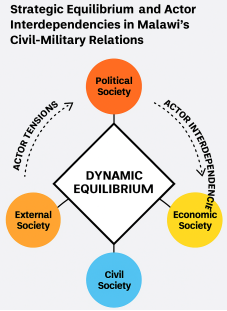
The Rhombus Diamond Framework provides a diagnostic tool for navigating these tensions
| [2] | Chazema, T. A. (2024). Reframing civil-military equilibrium in transitional democracies: Indigenous models and strategic diagnostics from Malawi. AfroISME Working Paper Series, 3(1), 15-38. |
| [3] | Chazema, T. A. (2025). Balancing Power and Democracy: A Framework for Managing Civil-Military Relations in Democratic Malawi (PhD Thesis). Mzuzu University. |
[2, 3]
, as shown in
Figure 1. By positioning the military as a fulcrum that balances four civilian actors—elected authorities, civil authorities, civil society/media, and the judiciary—the framework enables the strategic mapping of effectiveness and institutional interdependencies. It moves beyond binary models of control to embrace a more fluid, participatory conception of CMR, grounded in local realities and indigenous epistemology.
Figure 1. Diagnostic Civil-Military Tensions in Malawi.
This visual map illustrates the dynamic equilibrium around MDF high, highlighting actor interdependencies and stress points, such as weak oversight, politicization, and role ambiguity.
Comparative insights from Ghana, Zambia, and Argentina reinforce the importance of institutional integrity and civic education. Ghana’s parliamentary reforms have strengthened defence oversight through specialized committees and technical support
. Zambia’s DSTCs have evolved into responsive local security platforms, aided by decentralized funding and more explicit mandates
. Argentina’s post-junta judicial reforms have bolstered constitutionalism and public trust, demonstrating the judiciary’s role in democratic consolidation
.
Malawi’s trajectory reflects both promise and fragility. The MDF’s professionalism and constitutional loyalty are commendable, but sustained effectiveness requires systemic reform across all categories of actors. Strengthening meritocracy, fostering inter-agency dialogue, and integrating the Rhombus Diamond Framework into national security policy can help recalibrate the CMR for long-term stability and democratic resilience.
6. Policy Implications
In agreement with Young’s study on governance and African political economy
, the findings of this study point to several strategic interventions that can enhance the effectiveness of CMR actors in Malawi. These policy recommendations are grounded in empirical insights and aligned with the Rhombus Diamond Framework’s emphasis on actor equilibrium and participatory governance:
1) Institutionalize merit-based appointments: Ensuring that leadership positions across the military, judiciary, and civil service are filled based on competence rather than political affiliation will strengthen professionalism and reduce patronage-driven distortions in CMR.
2) Establish joint training programs: Cross-sectoral training involving parliamentarians, civil servants, military officers, and civil society actors can bridge the familiarity gap, foster mutual understanding, and improve inter-agency coordination.
3) Expand civic education on security governance: Public awareness campaigns and school curricula should include content on the roles and responsibilities of CMR actors to demystify the military and promote informed citizen engagement.
4) Strengthen decentralized security structures: Enhancing the capacity, funding, and mandate clarity of District Security Technical Committees (DSTCs) can improve local responsiveness and embed democratic oversight at the grassroots level.
5) Integrate the Rhombus Diamond Framework into national security policy: Adopting this diagnostic model can guide strategic planning, actor mapping, and performance evaluation, ensuring that no single institution dominates the security architecture.
Together, these interventions can foster a more balanced, transparent, and accountable CMR ecosystem. An ecosystem that supports democratic consolidation while preserving operational effectiveness.
7. Conclusion
The effectiveness of civil-military relations actors in Malawi is uneven but evolving. While the Malawi Defence Force has emerged as a stabilizing institution marked by professionalism and public trust, civilian actors face persistent challenges in oversight, coordination, and strategic engagement. Bridging these gaps requires systemic reforms grounded in meritocracy, joint training, civic education, and decentralized capacity-building. The Rhombus Diamond Framework offers a context-sensitive model for diagnosing institutional performance and recalibrating actor roles. As Malawi deepens its democratic consolidation, embedding this framework into national security policy can foster participatory governance, safeguard constitutionalism, and ensure a balanced, resilient civil-military ecosystem.
Abbreviations
CMR | Civil-Military Relations |
CSO | Civil Society Organisations |
DSTC | District Security Technical Committee |
MDF | Malawi Defence Force |
Author Contributions
Thokozani Andrew Chazema: Conceptualization, Data curation, Formal Analysis, Funding acquisition, Investigation, Methodology, Project administration, Resources, Software, Validation, Visualization, Writing – original draft, Writing – review & editing
Mavuto Tembo: Conceptualization, Methodology, Supervision, Writing – review & editing
Chrispin Mphande: Formal Analysis, Supervision Writing – review & editing
Robert McNab Kerr: Supervision, Validation
David Kumwenda: Conceptualization, Validation
Conflicts of Interest
The authors have declared that no competing interests exist.
References
| [1] |
Charmaz, K. (2006). Constructing grounded theory: A practical guide through qualitative analysis. Sage Publications.
|
| [2] |
Chazema, T. A. (2024). Reframing civil-military equilibrium in transitional democracies: Indigenous models and strategic diagnostics from Malawi. AfroISME Working Paper Series, 3(1), 15-38.
|
| [3] |
Chazema, T. A. (2025). Balancing Power and Democracy: A Framework for Managing Civil-Military Relations in Democratic Malawi (PhD Thesis). Mzuzu University.
|
| [4] |
Feaver, P. D. (1996). The Civil-Military Problem: Huntington, Janowitz, and the Question of Civilian Control. Armed Forces & Society, 23(2), 149-178.
https://doi.org/10.1177/0095327X9602300203
|
| [5] |
Griner, A. (2016). Parliamentary oversight of the security sector: Principles, mechanisms and practices. Geneva Centre for the Democratic Control of Armed Forces (DCAF).
https://www.dcaf.ch/parliamentary-oversight-security-sector
|
| [6] |
Huntington, S. P. (1957). The soldier and the state: The theory and politics of civil-military relations. Harvard University Press.
|
| [7] |
Janowitz, M. (1960). The professional soldier: A social and political portrait. Free Press.
|
| [8] |
Owens, M. T. (2012). What military officers need to know about civil-military relations. Naval War College Review, 65(2), 67-80.
https://www.usnwc.edu/getattachment/7e3c2e2e-5c5f-4b2f-9b3e-3c3e5f4a3d2e/Owens,-What-Military-Officers-Need-to-Know-about-Civ.aspx
|
| [9] |
Schiff, R. (1995). Civil-military relations reconsidered: A theory of concordance. Armed Forces & Society, 22(1), 7-24.
https://doi.org/10.1177/0095327X9502200102
|
| [10] |
Williams, R. (2017). Civil-military relations in Africa: Navigating the democratic terrain. African Security Review, 26(1), 3-18.
https://doi.org/10.1080/10246029.2016.1266223
|
| [11] |
Welch, C. E. (1976). Civilian Control of the Military: Theory and Cases from Developing Countries. SUNY Press.
|
| [12] |
Williams, R. (2015). Enhancing Democratic Control of the Armed Forces in Africa: A Review of Policy Instruments. ISS Monograph Series.
|
| [13] |
Ylönen, A. (2016). Political Settlements and Security Sector Governance in Africa. African Security Review, 25(4), 400-413.
https://doi.org/10.1080/10246029.2016.1206253
|
| [14] |
Young, T. (2004). Governance, the World Bank, and liberal theory. Review of African Political Economy, 31(99), 411-430.
https://doi.org/10.1080/0305624042000262265
|
| [15] |
Zürcher, C. (2007). Post-conflict development: A weak state and strong international support. Conflict, Security & Development, 7(2), 173-200.
https://doi.org/10.1080/14678800701333045
|
Cite This Article
-
APA Style
Chazema, T. A., Tembo, M., Mphande, C., Kerr, R. M., Kumwenda, D. (2025). Strategic Equilibrium in Civil-Military Relations: Insights from Malawi’s Democratic Transition. International and Public Affairs, 9(2), 52-58. https://doi.org/10.11648/j.ipa.20250902.11
 Copy
|
Copy
|
 Download
ACS Style
Chazema, T. A.; Tembo, M.; Mphande, C.; Kerr, R. M.; Kumwenda, D. Strategic Equilibrium in Civil-Military Relations: Insights from Malawi’s Democratic Transition. Int. Public Aff. 2025, 9(2), 52-58. doi: 10.11648/j.ipa.20250902.11
Copy
|
Download
AMA Style
Chazema TA, Tembo M, Mphande C, Kerr RM, Kumwenda D. Strategic Equilibrium in Civil-Military Relations: Insights from Malawi’s Democratic Transition. Int Public Aff. 2025;9(2):52-58. doi: 10.11648/j.ipa.20250902.11
Copy
|
Download
-
@article{10.11648/j.ipa.20250902.11,
  author = {Thokozani Andrew Chazema and Mavuto Tembo and Chrispin Mphande and Robert McNab Kerr and David Kumwenda},
  title = {Strategic Equilibrium in Civil-Military Relations: Insights from Malawi’s Democratic Transition},
  journal = {International and Public Affairs},
  volume = {9},
  number = {2},
  pages = {52-58},
  doi = {10.11648/j.ipa.20250902.11},
  url = {https://doi.org/10.11648/j.ipa.20250902.11},
  eprint = {https://article.sciencepublishinggroup.com/pdf/10.11648.j.ipa.20250902.11},
  abstract = {This article examines the strategic equilibrium of civil-military relations in democratic Malawi, focusing on the effectiveness of institutional actors in striking a balance between military professionalism and democratic accountability. Drawing on qualitative data from 65 informants across the judiciary, legislature, civil society, and the Malawi Defence Force (MDF), the study conceptualizes effectiveness as a dynamic interplay of constitutional fidelity, participatory engagement, and operational legitimacy. It integrates four theoretical traditions: Huntington’s Institutional Theory, Schiff’s Concordance Theory, Feaver’s Agency Theory, and Janowitz’s sociological perspective, providing a multidimensional lens for evaluating actor performance in transitional democracies. The Rhombus Diamond Framework is introduced as a diagnostic tool that positions the military as a fulcrum balancing four civilian nodes: elected authorities, civil authorities, civil society/media, and the judiciary. Effectiveness is assessed using five indicators: deliberative participation, monitoring mechanisms, judicial responsiveness, operational satisfaction, and peace/security outcomes. Findings reveal that while the MDF enjoys high public trust and operational competence, civilian actors face persistent challenges, including technical capacity gaps, politicization, and institutional inertia. Comparative insights from Ghana, Zambia, and Argentina underscore the importance of meritocracy, civic education, and institutional integrity in fostering effective civil-military relations. The study highlights the need for recalibrated actor roles, joint training programs, and decentralized security structures to bridge the familiarity gap and enhance participatory governance. By integrating indigenous epistemology with comparative analysis, the article presents a context-sensitive model for assessing institutional performance and informing policy reform. Ultimately, this study contributes to academic and policy debates by offering a grounded, actor-specific framework for strengthening democratic oversight and sustaining strategic equilibrium in civil-military relations. It advocates for embedding the Rhombus Diamond Framework into national security policy to promote balanced governance, safeguard constitutionalism, and ensure resilient civil-military synergy in transitional democratic contexts.},
 year = {2025}
}
Copy
|
Download
-
TY  - JOUR
T1  - Strategic Equilibrium in Civil-Military Relations: Insights from Malawi’s Democratic Transition
AU  - Thokozani Andrew Chazema
AU  - Mavuto Tembo
AU  - Chrispin Mphande
AU  - Robert McNab Kerr
AU  - David Kumwenda
Y1  - 2025/12/09
PY  - 2025
N1  - https://doi.org/10.11648/j.ipa.20250902.11
DO  - 10.11648/j.ipa.20250902.11
T2  - International and Public Affairs
JF  - International and Public Affairs
JO  - International and Public Affairs
SP  - 52
EP  - 58
PB  - Science Publishing Group
SN  - 2640-4192
UR  - https://doi.org/10.11648/j.ipa.20250902.11
AB  - This article examines the strategic equilibrium of civil-military relations in democratic Malawi, focusing on the effectiveness of institutional actors in striking a balance between military professionalism and democratic accountability. Drawing on qualitative data from 65 informants across the judiciary, legislature, civil society, and the Malawi Defence Force (MDF), the study conceptualizes effectiveness as a dynamic interplay of constitutional fidelity, participatory engagement, and operational legitimacy. It integrates four theoretical traditions: Huntington’s Institutional Theory, Schiff’s Concordance Theory, Feaver’s Agency Theory, and Janowitz’s sociological perspective, providing a multidimensional lens for evaluating actor performance in transitional democracies. The Rhombus Diamond Framework is introduced as a diagnostic tool that positions the military as a fulcrum balancing four civilian nodes: elected authorities, civil authorities, civil society/media, and the judiciary. Effectiveness is assessed using five indicators: deliberative participation, monitoring mechanisms, judicial responsiveness, operational satisfaction, and peace/security outcomes. Findings reveal that while the MDF enjoys high public trust and operational competence, civilian actors face persistent challenges, including technical capacity gaps, politicization, and institutional inertia. Comparative insights from Ghana, Zambia, and Argentina underscore the importance of meritocracy, civic education, and institutional integrity in fostering effective civil-military relations. The study highlights the need for recalibrated actor roles, joint training programs, and decentralized security structures to bridge the familiarity gap and enhance participatory governance. By integrating indigenous epistemology with comparative analysis, the article presents a context-sensitive model for assessing institutional performance and informing policy reform. Ultimately, this study contributes to academic and policy debates by offering a grounded, actor-specific framework for strengthening democratic oversight and sustaining strategic equilibrium in civil-military relations. It advocates for embedding the Rhombus Diamond Framework into national security policy to promote balanced governance, safeguard constitutionalism, and ensure resilient civil-military synergy in transitional democratic contexts.
VL  - 9
IS  - 2
ER  -
Copy
|
Download





 Share This Article
 Twitter
 Linked In
 Facebook